Value-First, Worker-Centered AI Exploration

Social Workers Define the Do's and Dont's of LLM in Their Work

Workshop Facilitation

Workshop Facilitation

UX Research

UX Research

Graphic Design

Graphic Design

Rapid Prototyping

Graphic Design

Rapid Prototyping

Image-Making and Illustration

My Role

UX Designer at the University of Texas at Austin, Human-AI Interaction Lab

Tools

  • Miro

  • Figma

  • ATLAS.TI

My Contributions

  • Planned out workshop flow from introductions (I picked the "Fears & Hopes" exercise for this project) to post-workshop questionnaire.

  • Met with 15+ social workers to learn about what got them into social work, their biggest pain points at work, and ways that LLM could help or hurt their work. This was my favorite part about this project.

  • Designed the LLM Capability Card Deck, which broke down things that LLM can do into 8 tiers, from simple to complex.

In Short…

Large Language Models (LLM) like Microsoft Copilot, Chat GPT, Claude, and Google Gemini promise faster, easier, and smarter workflows. However, not all of them center worker needs, agency, and values.

Moreover, organizations often push new technologies onto workers without soliciting or incorporating workers’ priorities.


So, how do we give workers sufficient knowledge on LLM capabilities to build the tools that center their needs?
Centering Worker's Values and Needs Through Co-Design

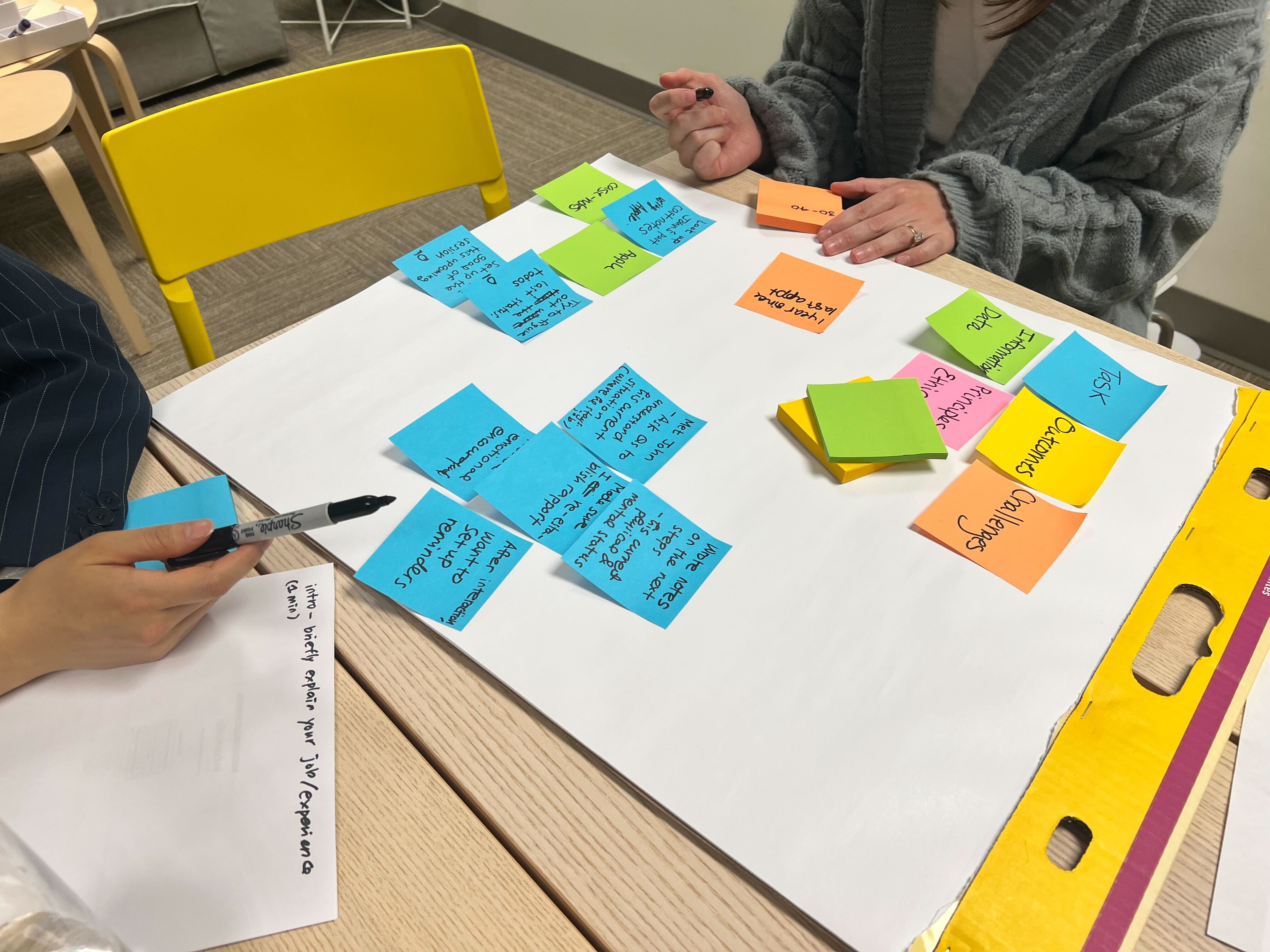
To address it, we employed the Co-Design method along with an LLM Capability Card Deck. Our aim was to design with, not for, our users.

What is Co-Design?

Co-design is a collaborative approach where designers work together with non-designers to create solutions. Designers act as facilitators and guide the participants through the design process. Co-design aims to harness the collective wisdom and insights of everyone involved, especially the end-users, to innovate and solve problems effectively.

A Case Study: Co-Designing LLM Tools with Social Workers

Starting out as a partnership with the City of Austin in 2023, our team conducted two-phased co-design sessions with fifteen practicing social workers to generate more than 100 ways that LLM could help their workflow by translating LLM capabilities into approachable, user-oriented representations.

Study Overview Graphic. A structured two-session framework for aligning workflows with AI support: from mapping tasks and determining AI integration levels to generating synthetic data and prototyping LLM-driven solutions.

Bloom-Aligned Capability Cards

The Capability Cards were key to helping non-technical stakeholders understand, discuss, and design with LLM’s. We used Bloom’s Taxonomy to organize LLM capabilities into six categories. This helped connect workers’ experience to what an LLM could do and surface differing levels of complexity involved in performing capabilities across the Bloom’s Taxonomy ladder.

Since day 1 of my UX design career I etched this short video clip into my long-term memory as a cautionary tale. I swear to never design pretty yet inaccessible UI on a whim and puts the developer through hell. To keep my oath, I follow industry best practices to avoid double-work for my team and ensure making design changes is easy and scalable. Soon after my team okyed my initial draft, I established a design system built with Figma local variables and components and made adjustments as I went.

Cards preview

An animation that illustrates how our team used the Bloom’s Taxonomy to organize LLM capabilities so they were easier for our users to understand.

Cards preview

Each card represents a different kind of thinking a model can perform—like remembering, analyzing, or creating—based on Bloom’s Taxonomy. By sorting capabilities into these levels, the cards make LLM behavior easier to see, compare, and discuss.

Since day 1 of my UX design career I etched this short video clip into my long-term memory as a cautionary tale. I swear to never design pretty yet inaccessible UI on a whim and puts the developer through hell. To keep my oath, I follow industry best practices to avoid double-work for my team and ensure making design changes is easy and scalable. Soon after my team okyed my initial draft, I established a design system built with Figma local variables and components and made adjustments as I went.

What's on the card

By organizing LLM capabilities into Bloom’s Taxonomy’s categories, we turned abstract possibilities into concrete functions. This approach also offer users, especially non-experts, a transparent view of its capabilities.

Since day 1 of my UX design career I etched this short video clip into my long-term memory as a cautionary tale. I swear to never design pretty yet inaccessible UI on a whim and puts the developer through hell. To keep my oath, I follow industry best practices to avoid double-work for my team and ensure making design changes is easy and scalable. Soon after my team okyed my initial draft, I established a design system built with Figma local variables and components and made adjustments as I went.

Without this structured breakdown, many users underestimate the extent of decision-making power they delegate to an LLM. By visualizing these capabilities through the Bloom’s Taxonomy ladder, users gain both transparency and control, becoming more aware of the LLM’s impact on tasks like creating, categorizing, and evaluating.

Since day 1 of my UX design career I etched this short video clip into my long-term memory as a cautionary tale. I swear to never design pretty yet inaccessible UI on a whim and puts the developer through hell. To keep my oath, I follow industry best practices to avoid double-work for my team and ensure making design changes is easy and scalable. Soon after my team okyed my initial draft, I established a design system built with Figma local variables and components and made adjustments as I went.

Project Impacts

15+

Social Workers Interviewed

100+

LLM ideas generated by workers

3

LLM readiness tiers for social work tasks identified

© 2026 Meah Lin. All Rights Reserved.

© 2026 Meah Lin. All Rights Reserved.

© 2026 Meah Lin. All Rights Reserved.

© 2026 Meah Lin. All Rights Reserved.

Create a free website with Framer, the website builder loved by startups, designers and agencies.